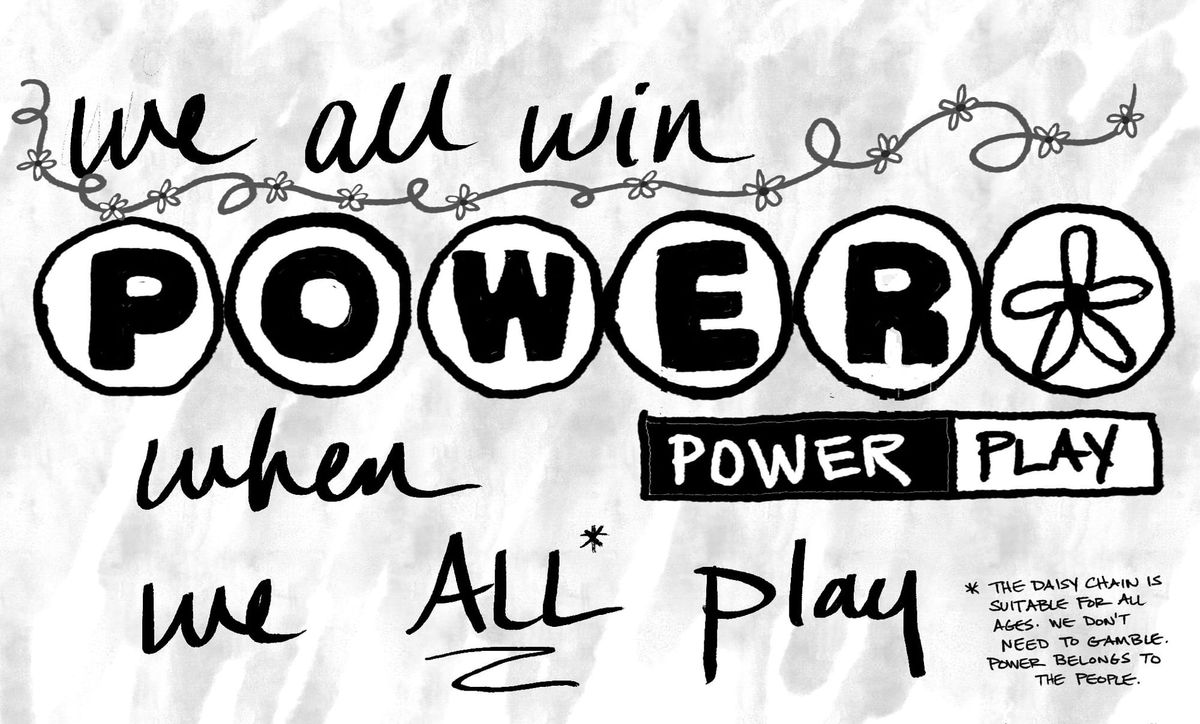
We All Win When We ALL Play
We are our most innovative and attuned to possibility when we play.
Consider play styles of young children playing a game of make-believe. Because their aim is to keep playing:
they take turns
they suggest new ideas
they mess up and try again
they appreciate each other’s efforts
they talk about what isn't working without getting defensive.
Even in the midst of conflict, they recognize what they’d lose if they give up, so they let their emotions flow through them and return to a state of play.
Pure play is the source of adaptation; there hasn't been a single bit of genius on this planet that wasn't borne through play. We will need this creative genius to move around otherwise insurmountable obstacles and outsmart those who would bamboozle and threaten a free people into submission or passive resignation.
How to Shift from Reading to Playing with The Daisy Chain
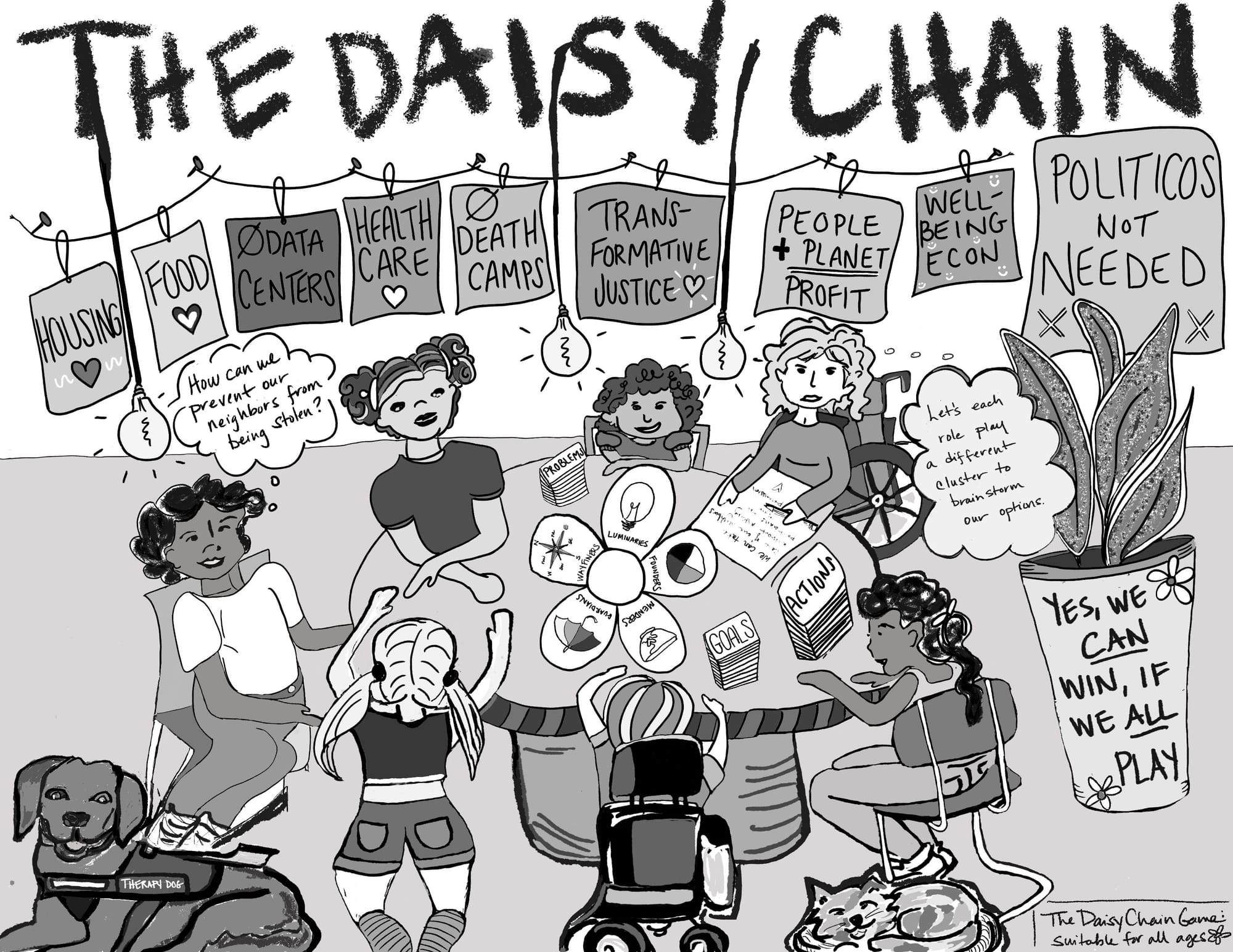
[Caption: Daisy Chain Game, by GPat Patterson & Nikolas Lee]
For The Daisy Chain to be worth anything, you need to actually use it in real life. Fortunately, there’s something we can all do to make sure we practice: to help bridge the gap between reading The Daisy Chain to using it to organize our neighborhoods, we can transition to tabletop gaming to shift us into actual community practice.
Who Can Play
It is important for neighbors of all ages and experiences to understand they have something important to contribute to their communities. I recommend centering children and other often-silenced groups when playing The Daisy Chain. Related, it’s important to prioritize playing this with people in your actual neighborhood, even if it’s just a handful of folks in the mountain hollers of Johnsonville, NC.
Given the way the federal government, its avatars, and its quislings have branded ordinary people as “threats” to “national security,” it’s important to understand that bad actors may attempt to wheedle their way into community groups. For that reason, I recommend using the Kevin Bacon[1] test to vouch for your neighbors.
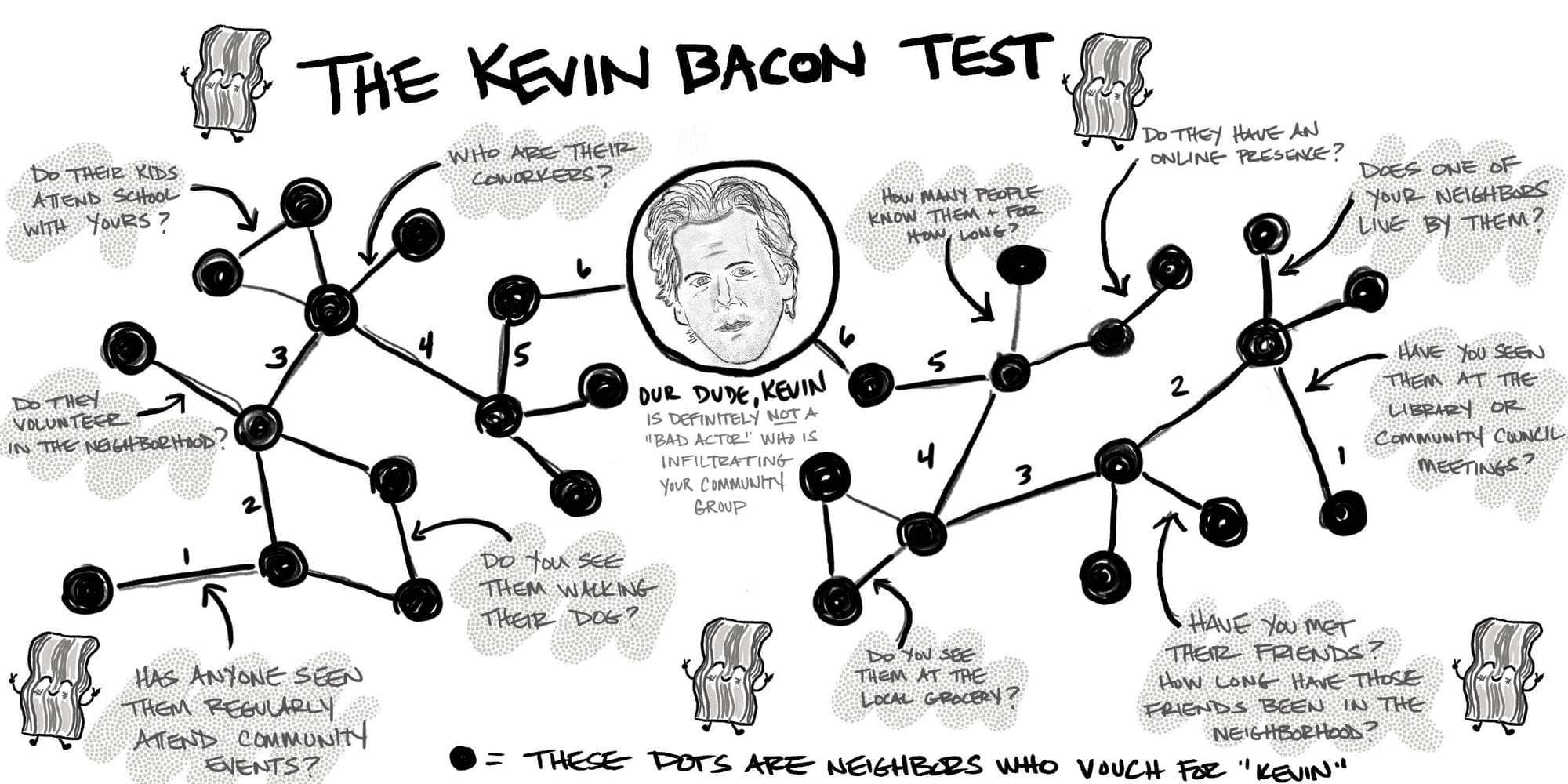
[Caption: The Kevin Bacon Safety Test, by GPat Patterson]
Where to Play
The Daisy Chain can be played anywhere, but I especially recommend playing it at libraries, schools, churches, playgrounds, and community centers. Technically, you could even play a street version of The Daisy Chain using multicolored sidewalk chalk. There’s no wrong way to play The Daisy Chain game, except not to play it.
How to Build the Game
You don't necessarily need money to create a tabletop game for The Daisy Chain. I’s better to crowdsource game-making materials and to invite young people to take the lead in creating the game board.
Intention is everything: when neighborhood groups collaborate to create these board games, they enact the very community spirit The Daisy Chain calls on us to embody. By inviting young people to create the board game, we are also reminded that (1) adults in the room cannot remain in learned helplessness and (2) we have a responsibility to act on behalf of young[2] people, who will inherit whatever comes next.
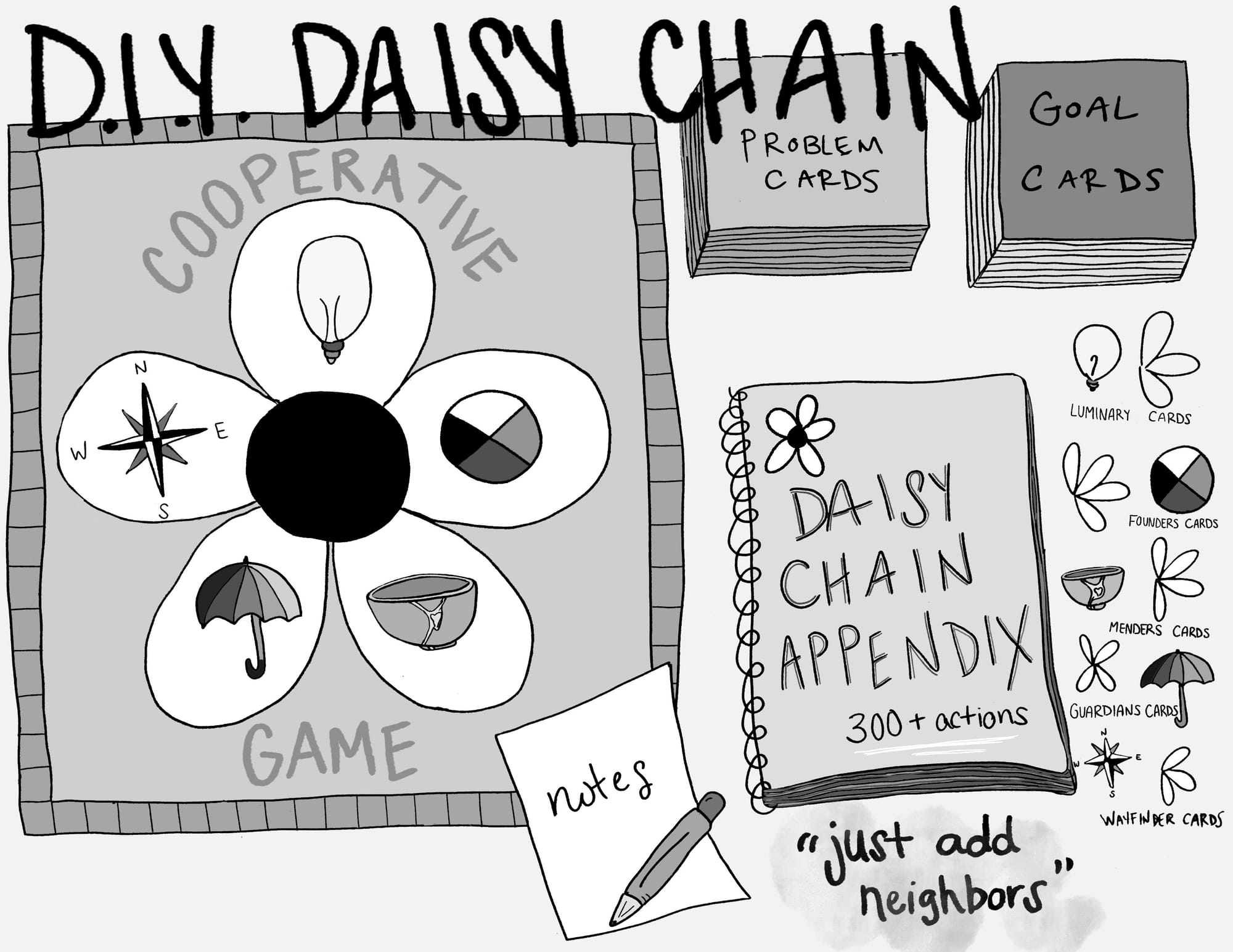
[Caption: D.I.Y. Daisy Chain Game, by GPat Patterson & Nikolas Lee]
Supplies Needed
There are six items needed to create a DIY Daisy Chain game:
Cardboard to create a five-petal[3] daisy-shaped game board.
Printed or hand-drawn map[4] of your +4 postal code or daisy-chain radius area[5]
Construction paper or cardstock for creating the 18 petal cards[6]
Index cards or sticky notes for creating problem cards [7] and goal cards[8]
Copy of The Daisy Chain and especially its Appendix[9]
Paper and pencil for taking notes[10].
How to Play the Game
If there’s something emergent or on your heart, work with pressing problems and goals. If you’re feeling stuck, begin by drawing one problem card and[11] one goal card. Use The Daisy Chain heuristic and the appendix to brainstorm how your neighborhood might pull from different daisy petals to address that problem or goal.
Keep in mind, this game is a recursive brainstorming exercise. You’re meant to play it over and over again— and you’re meant to have conversations with other people playing The Daisy Chain.
For those with experience playing Dungeons and Dragons, Magik the Gathering, or other cooperative tabletop games that involve role-playing, it might be helpful to volunteer[12] your services as a Narrators, Imagineers, and/or Dungeon Master. While this role isn’t entirely necessary, it might be helpful for someone to imagine what a coercive adversary might do to foil your plans. It is just as important for creative brave-hearts to imagine how neighbors might adapt or “sprout more petals” for strength to meet the challenge.
Similarly, It may also be helpful to imagine how your daisy chain might collaborate with nearby daisy neighborhoods facing a climate crisis or an attack[13] by political abusers. This will help you identify your neighborhood’s strengths. It will also inadvertently help you anticipate your neighborhood’s vulnerabilities[14] and the help your neighbors might need in crisis.
The point of doing this is to draw on the neuroscience of play, because when we use our imaginations to game out scenarios, it makes us more adaptable when we face a similar scenario in real life, even if the details we experience are much different. The idea is to have a rough map.
Making Daisy Chain Games a Community Event
Neighborhoods can sponsor a town- or city-wide Daisy Chain Games: one part euchre tournament and one part Sesame Street meets Stranger Things. Each Daisy Chain cluster can give themselves neighborhood team names, related to neighborhood lore or landmarks. The idea here is to play in simultaneous clusters, then host a larger pizza party (or potluck) where you talk about how each group gamed out scenarios[15], almost like a book of plays coaches have in sports-ball.
From Play to Neighborhood Praxis
To shift from playing the game to practicing it, first start by meeting pro-social neighborhood goals. This will turn your neighborhoods into brave spaces and beloved communities and will instill a sense of community[16] confidence. From there, draw on community LARPing skills to begin practicing neighborhood drills for emergency related scenarios. If you’re practicing for something intimidating, use whimsy[17] and celebration to lessen community fear and strengthen community bonds. Whimsy can also be an aid in shielding[18] you from surveillance.
Whether we’re addressing a problem or meeting a neighborhood goal, our aim must be experimentation and beginner’s mind over perfection[19]. Collaboration and showing mutual appreciation as we practice is crucial. The goal is for neighbors to activate petals that address specific objectives and/or meet community needs. It’s also important to remember to be flexible, adapt, and allow what isn’t working to compost: We will have short-term and long-term goals. Some campaigns will end. Some leaders who are right for one moment aren’t suited for the next. Move in horizontal, not top-down formation.
Playing together to solve a problem and adjusting when things aren't quite working is exactly how kids play: for the love of movement, experimentation, and the wielding of possibility. Play is where adaptation, affection, and community converge, and that is precisely how power is built.
This regenerative style of mass-cooperation also has the added benefit of creating political permacultures where political abuse is unable to take root.
But more than that, we shape the future by practicing it in the present. In the process, we build interconnected ecosystems made for adaptation and collaboration.
There is simply no way out of the challenges we face without relearning how to play together.
Chapter 5 Footnotes
This is a reference to an old Gen-Xer joke that every actor a mere six degrees of separation from knowing Kevin Bacon. In this context, the Kevin Bacon test is about engaging in peer-to-peer vetting. While we do want to get to know people who live in our neighborhood, it’s a red flag if no one in your community can vouch for that the person actually lives in your neighborhood. If no one can vouch that the person lives in your neighborhood or can claim them as part of the community, it’s a good idea to get to know that person better and verify their standing in the community before inviting them to play. As adrienne maree brown points out in her book, Emergent Strategy, movements must move “at the speed of trust.” ↩︎
I have mentioned this on loop, but when I refer to young people I mean: (1) all the world’s children, not just the ones we know and (2) all young people [human, animal, critter, and organic beings] who will inherit the world from us, even generations into the future. Our purpose in this life isn’t to amass things or confused success with our ability to insulate ourselves from discomfort. Each of us are responsible to care for, tend to, and repair the tapestry of life. ↩︎
I recommend a five-petal daisy to correspond to the five thematic clusters of The Daisy Chain. In fact, I recommend drawing/crafting the cluster symbols onto each of the five petals: lightbulb (Luminaries), medicine wheel (Founders), kintsugi bowl (Menders), umbrella (Guardians), nautical compass (Wayfinders). ↩︎
This map should include local landmarks, topographical changes, major arteries in and out of your neighborhood, green spaces, playgrounds, schools, places of worship, police precincts, community gardens, treaty lands, water ways, community centers, and notable nooks and crannies that might become important for those in the jumble and lionize petals. It is important to keep maps like these for community eyes only; do not play this game without vetting people with the Kevin Bacon test— and always, always listen to your uh-oh feeling. Remember that we’re living during a time where the US federal government is surveilling people’s church services; these political abusers have no boundaries and no scruples. ↩︎
For some people, the +4 postal code might not make sense. This could be because folks are living in dense cities or rural areas of the US, or the people using The Daisy Chain are organizing somewhere blissfully outside the borders of the USA. Remember that your Daisy Chain staging ground is a 10-30 minute walking radius, or a 5-20 minute biking radius. If y’all have ponies or sled dogs, consider me impressed. ↩︎
You can either print out the square-shaped petal cards included in the appendix, or you could simply cut out 18 petal shapes out of cardstock or construction paper. If I hadn’t anticipated people printing and photocopying The Daisy Chain field guide, I’d have chosen different colors to represent each petal in the visual heuristic of The Daisy Chain. The more colorful the better. Let your whimsy guide you— and remember: if your community feels it needs a new petal: grow one. ↩︎
There are people in your neighborhood who have already considered your neighborhood's vulnerabilities and challenges, when it comes to political coercive control and natural disasters. Onboard your neighborhood worrywarts, veterans, rangers, Scouts, environmentalists, and Cassandras. This is one part of your hive mind. ↩︎
Invite young people and visionaries of all ages to create your goal cards. These are the people who insist on their right to self-govern, co-create their own future, and make the neighborhood a place of joyful resistance. This is the second part of your neighborhood’s hive mind. ↩︎
The Daisy Chain Appendix is a litany of our collective agency, no matter what comes at us. The 300+ methods of mass-cooperation and mass-noncompliance listed in the appendix is just to get you started. You will think of more things to add to that list. Write them down. Similarly, there are things I couldn’t write down, either because I didn’t want to give lousy political abusers any ideas, or (also likely) because I don’t know the contexts and affordances of your area. ↩︎
I recommend using paper and pen for a number of reasons. First, it helps us think in a way that’s materially different from screen writing. Second, political abusers in the US (and elsewhere) have a massive surveillance network. I think it’s just a really good practice to go low-tech or tech-free when planning civilian defense strategies. Gentle reminder that the POTUS recently gloated about the possibility of nuking San Diego, CA. This is a “trust god and lock your doors” kind of situation— but make it “trust trees and ditch your devices.” Lastly, and I do hope this goes without saying: don’t run your community defense plan through an AI model. Fascists build that tech, and you’re giving them local knowledge they wouldn’t have otherwise had access to had some “fool of a Took” not uploaded bespoke plans in the Eye of Sauron. As Gandalf had once said: “Keep it secret. Keep it safe.” [And, no, I don’t care if it’s a locally hosted model. Use your noodle.] ↩︎
Alternate rounds by focusing on one problem scenario and one goal scenario. It's recommend alternating, because there will be an impulse to just focus on problem cards. I get that anxiety, but dabbling exclusively in problems, particularly responding to your political abusers, only givens them more power. It’s important to focus on goals as a matter of going on offense. Indeed, while I would never recommend a problems-only round of the Daisy Chain, I enthusiastically recommend (for morale and visionary purposes) a goals-only version of The Daisy Chain. ↩︎
Take turns. Pass the mic. ↩︎
For example, if political abusers were rampaging a neighboring town, how might you collaborate with each other's petal clusters to ensure the town prevails? How might you prevent those abusers from picking off towns one-by-one? ↩︎
When thinking about your vulnerabilities, this can include anything from shielding political, protecting young and other vulnerable people, infrastructure challenges, ecological pressure points, pandemic preparedness, and resources a community might be cut off from should they find themselves under attack by political abusers. Listen to your Cassandras, scientists, veterans, rangers, and First Nations neighbors. It’d be peak hubris to say “that’ll never happen” during Times Such as These. ↩︎
Keeping the Kevin Bacon test in mind: don’t give up sensitive community plans during these gatherings. Stick to discussions of actions neighbors can take, without giving away sensitive information, timing, or anything bad actors can use to foil your plans. ↩︎
Your community needs actual leaders on the ground. Don’t look up for leaders— look around the Daisy Chain table. We are the leaders we’re looking for. Now is not the time for learned helplessness or fanciful rescue narratives about brave institutional leaders. Assume your elected officials do not have a plan. Assume your institutional figureheads and will abandon you to harm or pretend everything is normal. Assume law enforcement will enable or participate in abuse. Assume the federal government will not intervene in the face of medical or ecological crisis. That’s their entire game-plan: create chaos and loot. ↩︎
For example, communities may want to practice slow moving car caravans as a preparation for Operation Parking Lot, as a way to prevent political abusers from accessing the staging area they need to invade your communities. That’s a scary but necessary thing to prepare for, given the gleefulness of figures like Tom Hohman, who have all but promised to escalate terror on our neighborhoods, post Midterms. To prepare for practicing the car caravan, invite young people to decorate your cars with pro-democracy decorations, being extra decorative around those car plates. ↩︎
Related, one might do well to remember how our ancestors in WW2 removed, renamed, and obscured directional signage as a way to slow down outsiders terrorizing their communities. We may be in the age of smart phones, put without reliable directional signage, and in the face of jumbled house numbers, even the most resolute abduction force will have a hard time navigating. Our job isn’t to roll the welcome mat out for abusers. When practicing jumble drills like these, consider the value of wearing silly costumes. Inflatable unicorns, cryptids, and super heroes are a lot harder to surveil and identify. Let the muppet mayhem begin. ↩︎
If you strive for perfection, ego will get in the way. Don’t let perfect be the enemy of the good. The best plan is the one you practice, not the one that’s perfect on paper. ↩︎

Member discussion: