In this chapter we examine three different ways neighbors can apply The Daisy Chain: (1) in your neighborhood, (2) between neighborhoods, and, finally, (3) branching out to regional and national levels, which allow us to effect change on a larger scale.
Growing a Daisy Chain In Your Neighborhood
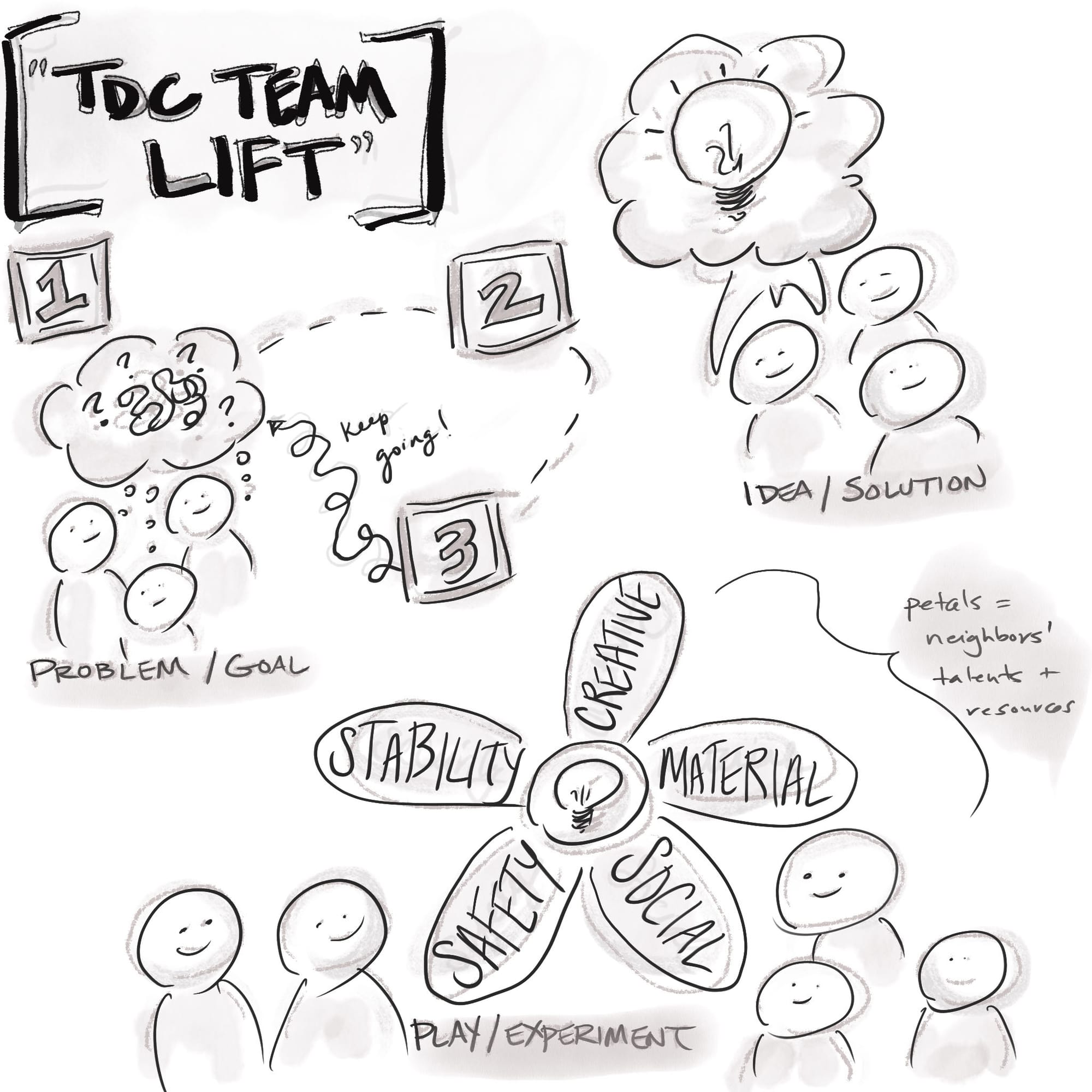
[Caption: The Daisy Chain Team Lift, by GPat Patterson]
Getting in a daisy chain formation begins by practicing “team lifts” in your immediate neighborhood— starting at the street, apartment complex, and postal code levels, then branching out into wider circles from there. As depicted in the illustration above and explained in the following section, the neighborhood team lift has three phases: (1) collective problem-solving, (3) pooling time, talents & resources, and (3) recursive experimentation.
Phase 1: Collective Problem-Solving
Neighbors come together to address a particular problem [1]. Other times, neighbors might come together with a specific goal [2] in mind. As mentioned in Chapter 2, neighbors can place any goal or problem at the center of the daisy. What we can do with this heuristic is limitless.
Phase 2: Pooling Time, Talents & Resources
Next, neighbors make note of those in their community who have the time, skills, talents, interests, hobbies, and resources that might help address some small part of the problem or reach some part of the goal. Rather than appealing to local governance or applying for a grant from an oligarch-owned foundation, neighbors work with what they have, where they’re at. No one carries a problem or goal alone. This is precisely why we practice The Daisy Chain as a “team lift.”
take a few deep breaths. you’re about to read a long list. wiggle in your seat. shake out the tension. make a funny sound. don’t try to answer all the questions. say aloud or silently to yourself: “neighbors approach big tasks together. there are people in my neighborhood who feel the same way i do and want to make a difference. we just haven’t found each other yet.”
Collaborative Questions to Address a Food Shortage
Continuing with the food shortage scenario, here’s a long list of questions that may arise when we’re thinking about a “team lift” around neighborhood food insecurity:
- which crops are still plantable in your community’s growing zone?
- who needs help harvesting and preserving the homegrown food they have?
- which neighbor knows plants that might still be foraged?
- who maps existing food resources across the neighborhood?
- which neighbors have seed on hand?
- which neighbors are skilled in seed-saving?
- which neighbor has gardening tools?
- which neighbors are willing to offer up their yards for planting?
- which neighbors will create crop markers for the plants?
- which neighbors will tend to those crops?
- who has expertise to develop inexpensive nutrient-dense meals from these food resources?
- who will volunteer to cook these meals?
- which neighbors have the means to store these prepared meals in freezers?
- which neighbors have backup generators if the freezers fail?
- which neighbors know how to create old-timey cold storage?
- which neighbors can track who needs meals and what food allergies exist?
- which neighbors can distribute meals?
- where and how will meals be distributed?
- which neighbors will teach young people food skills?
- who knows how to hunt or raise animals for food?
- which neighbor can teach others about food safety?
- where in your neighborhood can meal prep take place?
- which neighborhood spaces will host community meals?
- who will create flyers to advertise community meals?
- which neighbors will be willing to hang those flyers?
- which neighbors will schedule and coordinate community meals?
- which neighbors will facilitate community food planning meetings?
- which neighbors will follow up post-meeting to make sure things get done?
- which neighbors will make sure political abusers don’t destroy crops or raid dispersed food pantries?
- which neighbors will assist those most impacted by fears of food shortages?
- which neighbors will celebrate neighbors who take on this work?
- who will keep track of neighbors unable to access distribution sites?
- which neighbors can directly deliver meals to community members?
- which neighbors are able to offer transportation to help?
- who knows how to make use of kitchen scraps?
If a person were thinking individualistically, reading a list like this would seem daunting. But if you read this with a collective lens, you’ll begin to notice that the questions above activate all five clusters and all eighteen petals of The Daisy Chain. When lists like the one above are approached by the five Daisy Chain clusters, things start to feel doable. Check it out:
- Neighbors taking part in community education, using creative skills to decorate and build out gardens, and helping neighbors recognize their pooled resources all active the Luminaries cluster (imagine, educate, create petals).
- Neighbors growing food, observing dietary needs and food safety, storing food in dispersed locations, sharing food freely, keeping track of volunteer time for local time banks activate the Founders cluster (harvest, shelter, heal, share).
- Neighbors celebrating food-petal upstanders, helping neighbors process the grief of forced famines, making sure our targeted and vulnerable neighbors are fed, and deescalating confrontations with those who may attempt to interrupt our right to feed each other activates the Menders cluster (play, alchemize, lionize, deescalate).
- Neighbors dispersing food stores around the neighborhood, keeping locations of food stores secret, protecting gardens from vandals, feeding climate and political refugees in shelters activate the Guardians cluster (jumble, shield, attend, rescue).
- Neighbors monitoring actions and identities of food-famine quislings, neighbors who help plan and coordinate neighbors-feeding-neighbors initiatives, and neighbors documenting our efforts to feed each other, and neighbors writing a collective praxis statement that articulates our “founding food values” activate the Wayfinders cluster (investigate, unionize, document).
This example of using The Daisy Chain to address a food shortage is just one example of how neighbors might pool their resources and skills to achieve long- and short-term community goals. Regardless of what we face, crowdsourcing our skillsets and resources makes our communities stronger and more connected.
We can accomplish anything we set our collective time, talents, and resources toward. The Daisy Chain’s usefulness is as limitless as our collective potential.
Phase 3: Experimenting Recursively
The third phase isn’t final, because The Daisy Chain doesn’t offer a step-by-step, set-it-and-forget-it set of instructions [3]. This is a recursive process that will have many beginnings, middles, and ends: Challenges, goals, and questions will arise. Discoveries will be made. Additional needs will come to the fore. New and old neighbors will step up to fill in the gaps. People will make mistakes. People will honor their mistakes as lessons and try again. This is the rhythm.
Our focus must be on creating a new pattern that reclaims and retains people-power. There’s no getting back to a “normal” that’s been hurting people and the planet; we grownups must move toward our collective evolution—not something as flimsy and unstable as a revolution.
We’re not taking over the game: we’re walking away building a better one.
This is also why play is so important: play helps us tap into improvisation, creativity, good humor, camaraderie, and a willingness to keep going, even when the going gets grumbly.
Instead of a command-control structure, neighbors learn to flock together— pooling our time, talents, hobbies, interests, and energy to meet tangible community needs. When playing with The Daisy Chain, our differences transform into assets, and mutual appreciation becomes the engine that drives a real-life people-powered movement.
Logistically speaking, The Daisy Chain helps neighbors avoid bottlenecks by encouraging people to:
- move horizontally
- refuse to prune homegrown brilliance
- celebrate neighbors’ unique contributions
- allow what isn’t growing in service to each other to compost
- move where our energy takes us, instead of taking on resentments.
Once you understand how the Daisy Chain works at the smallest level, it’s flowers all the way down. Simply practice The Daisy Chain on a wider and wider scale.
Forming Daisy Networks between Neighborhoods
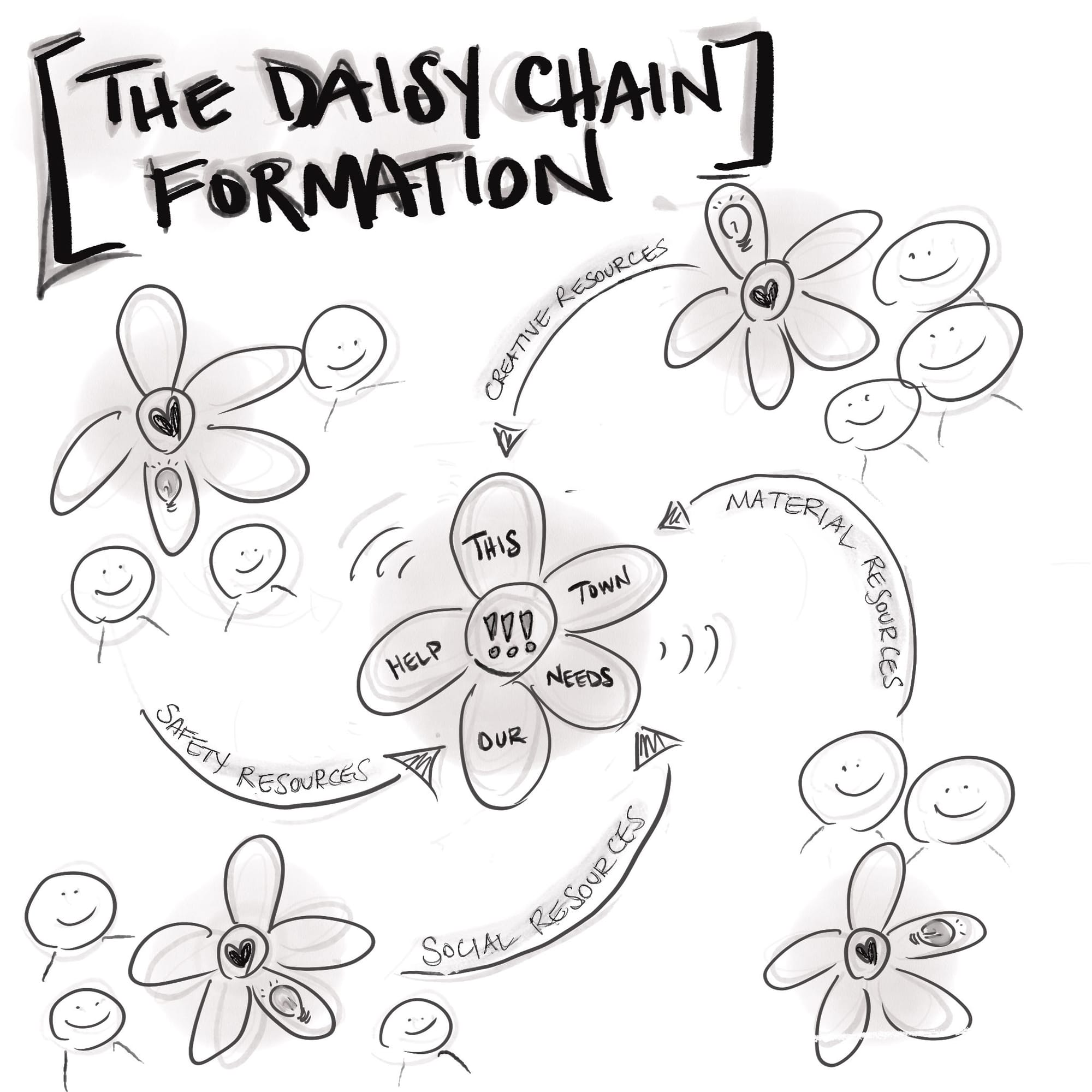
[Caption: Linking Neighborhoods with The Daisy Chain, by GPat Patterson]
Collaboration between neighborhoods is less like “sheet music” and more like jazz. We’re looking for enough of a shared bass line to move together.
When forming Daisy Chain networks between neighborhoods, it is important to understand that, from the outset, no single neighborhood Daisy Chain will look or operate exactly alike, because the conditions in each neighborhood vary. That variety is a good thing. All home turf is good turf, and we can use it all to our collective advantage when we think about how to use the diversity of our living spaces and topography to our advantage. Consider the following questions:
What are some things we can accomplish best in remote areas? Hunt, hide, and hold ground.
What are some things we can accomplish best in small towns and rural areas? Grow food, be tricksy, and shelter displaced neighbors.
What are some things we can accomplish best in suburban areas? Come to the relief of cities and boroughs, which are more likely to come under direct attack by political abusers. Harness plausible deniability [4] to move neighbors and needed materials between rural and city areas.
What are things we can accomplish best in city boroughs? Considering the physics of people-powered movements, city boroughs, which house the most dense neighborhoods are our center of gravity for creating murmurations that radiate outward to “the burbs and the rurbs [5].”
What are some things we can best accomplish in city centers? Make “business as usual” very unusual.
As author and organizer adrienne maree brown[6] reminds us, our collective thriving is directly related to our diversity— which includes a diversity of experience, culture, talents, resources, vulnerabilities, and topography.
How Networking between Daisies Helps Us
Because every Daisy Chain is rooted in a specific community, each community will naturally contribute different strengths and resources to the collective. This can lead to cross-community cooperation, reciprocity, and resilience.
Related, linking Daisy Chains can help us adapt, evolve, and survive crises and ruptures in our sense of normalcy[7]. With established local Daisy Chain formations in place, neighboring communities can spring into action to help each other; for example:
In situations of political or climate catastrophe, neighbors can help rescue or evacuate neighbors.
Neighboring communities can also provide collective assistance in rebuilding and repairing their neighborhoods in the aftermath of political or ecological disasters.
When one community finds themselves targeted by political abusers, neighboring Daisy Chain formations, not under siege, can provide needed supplies and skillsets— be that access to food, medics, photographers, lawyers, artists, healers, bus drivers, repair people, and those skilled in nonviolent deescalation tactics.
Regardless of the situation and topography, local Daisy Chains can lend resources from particular petals (in which they excel) without depleting their community’s resources.
These nimble experiments in coming to our neighbors’ aid also strengthen our own communities’ skillsets in real time. Better still, getting into formation between neighborhoods strengthens bonds between communities.
Ultimately, those who come to their neighbors’ aid take part in something not unlike the tradition of Japanese mending called kintsugi[8]—golden repair—in which broken pottery is mended with a lacquer mixed with gold, silver, or platinum— resulting in a container that is stronger and more beautiful in the mending. Through lending what is golden in one’s own community, we strengthen our own community and our bonds between communities. As author and visionary Octavia Butler[9] reminds us:
All that you touch
You Change.
All that you Change
Changes you.
Linking up between Daisy Chains is how we ultimately prevail: We refuse to be divided and we play on all turf like it’s our home turf. Because it is. This is our home. These are our neighbors and our neighborhoods, and we determine what happens next.
Creating Regional, National & International Murmurations
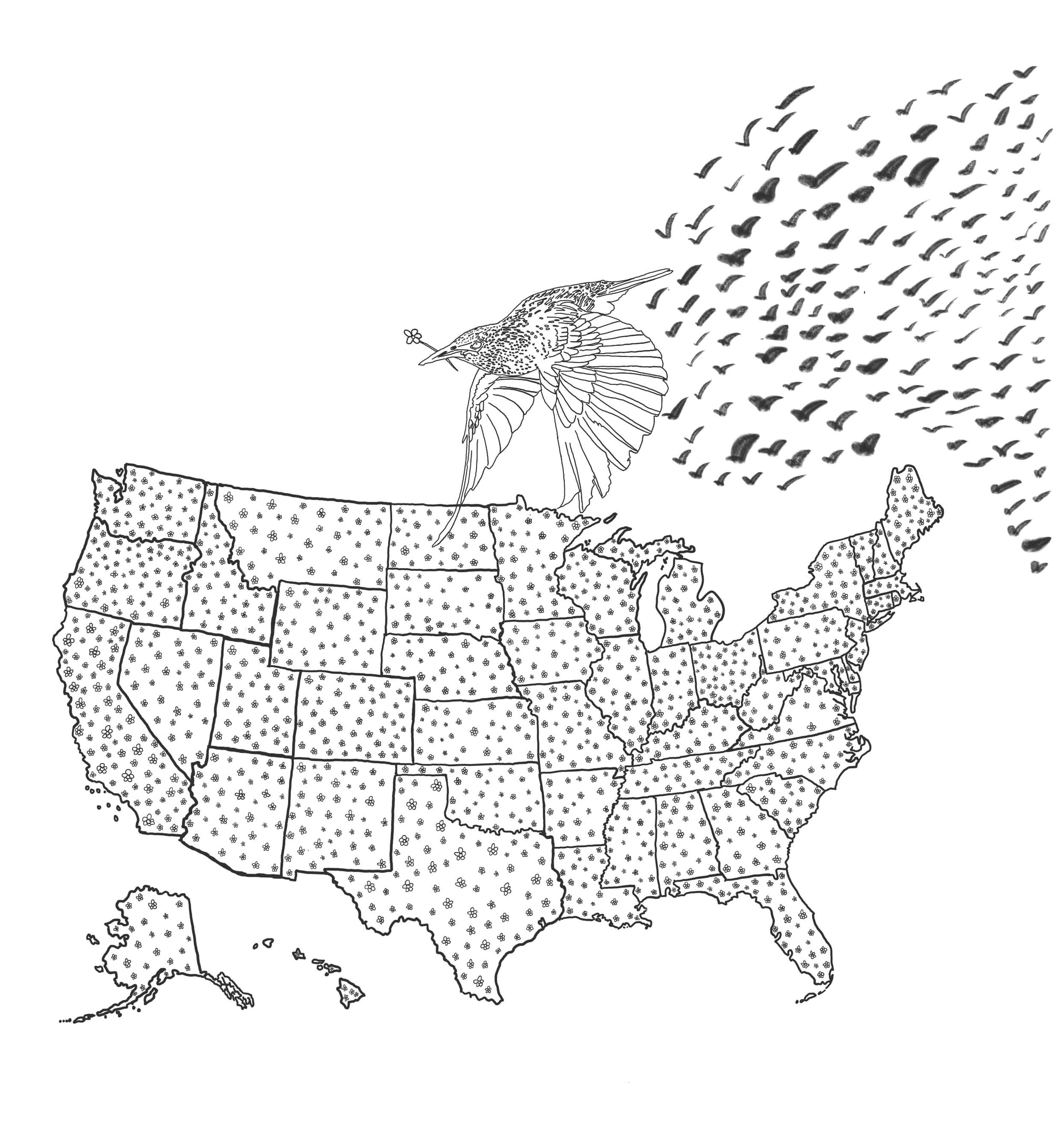
[Caption: Cross-Pollinating a National Movement, by Nikolas Lee]
The following sections illuminate some ways The Daisy Chain might help us accomplish goals and confront problems at regional, national, and international levels. To be clear, this is not a prescriptive or predictive list. One writer cannot anticipate everything, and one person’s vision ought not foreclose our collective vision of what we might accomplish together. Read knowing you’re meant to add to this list.
Regional Murmurations
Regional murmurations might occur at the county, state/province, and regional clusters. For example, in the United States, the Midwest, Southeast, and other areas can be considered regional clusters. Moving in murmuration at this level might include:
- collaborating to create dispersed hyperlocal food forests, based on more sustainable indigenous food systems
- creating regional time banks based on the same currency, allowing neighbors to trade across larger regions without relying on a currency rooted in abusive extraction of the land and dehumanizing labor practices
- creating schools for learning and practicing strategic nonviolent organizing, which are regionally and culturally applicable to the area
- gaming out emergency plans, be it responding to climate-related disasters and/or thwarting the invasion of bad actors who terrorize and disappear our neighbors
- developing independent, crowdsourced newspapers, off-grid regional communication, and regional festivals and celebrations that draw on local artists and creators to boost public morale
- coordinating efforts to register voters or engaging in massive Get Out the Vote campaigns for independent candidates who buck political abusers and align with ordinary people’s values[10].
This list represents only a handful of examples of how people in a region might exercise their defiant imaginations. The goal is to lean into our homegrown brilliance and shift the political and social ground—without asking for any institutional figurehead’s formal approval.
National Murmurations
When thinking about seeding national murmurations, it’s important to understand that it doesn’t take an entire population to bring about significant cultural shifts. One only needs to look at this current political moment, where a very small, unpopular group of people have committed themselves to doing great harm in a short amount of time. There are way more of us than there are of them, and we can pull of some incredible feats by out-organizing our political abusers. For some ideas, see the list below:
- Consider, for example, how policies that abuse workers might change if flight attendants, students, construction workers, truck drivers, or dock workers engaged in rolling work stoppages that started in one region for a week at a time before unpredictably popping up at another location across the country.
- One might work in collaboration across the country to engage in a digital exodus of oligarch-owned social media platforms by engaging in nation-wide pop-up clinics to help neighbors transition to federated, people-owned social media[11] and blogging platforms— which reject algorithms and are hardened off from disinformation, bots, trolls, and endless scrolling.
- Consider a student-led boycott of AI from university students, who engage in a mass-refusal to accept mandatory courses in AI training. Given the brilliance of young people in popularizing resistance movements, this student-led boycott could leader to a much larger, pro-human, national boycott[12] of AI.
- One might coordinate across regions to develop an intergenerational peace movement which—instead of appealing to political abusers to defund war machines and police states—directly appeals to security forces[13] to defect.
- Consider the power of a country full of children’s choirs hosting weekly concerts outside police precincts, sheriffs’ offices, and mayors’ offices, demanding that grownups refuse to participate in the kind of federally-sanctioned domestic terror that has led to masked goons executing, abducting, and torturing our neighbors.
- We might also create a popular cultural movement around reusing, upscaling, sharing, and borrowing goods in a way that resists oligarch schemes to keep people hooked on an economic system that abuses them and the environment[14].
- We can engage in an effort to create a nation-wide federation of time-banks[15], as a way to create a parallel currency (not rooted in the US dollar) that facilitates genuinely free trade, rooted in the unhoardable, unriggable currency of time— not bitcoin[16], which is one-hundred percent a ponzi scheme.
- Consider the effect of a nationwide self-imposed screen blackout; this would take the power away from our abusers by refusing to engage with their propaganda and walking away from the tools they’ve been using to surveil us at scale. Phones, smart watches, and screens in general are essentially ankle monitors— except our devices are not attached to our bodies[17]. We can put them down.
- Consider a national strike that involves people opting to walk, bike, skateboard, rollerblade, or adopt animal-powered local transportation as a rebuke to the fossil fuel industry, which has brought us endless wars and climate collapse. Imagine, too, if neighbors helped those in the auto industry unionize to build a massive public transit system rooted in solar power.
Again, each example reflects only a fraction of what we can accomplish together at a national level. For decades, our political abusers have breadcrumbed us and lied to us about what’s possible. But the real plot twist is that we don’t need politicians on our side; they need us— and if we shift together without them, they can either follow us or watch themselves become irrelevant. Them’s the breaks.
International Murmurations
When it comes to international murmurations, the entire global population need not get involved to make significant global change. Once more, if we think about the great harm caused by a global elite—which is more invested in endless hoarding than the well-being of humanity and our precious ecosystem— we begin to grasp that international murmurations can also effect significant change. We outnumber them by margins so wide that it’s literally impossible to visually represent how tiny this group of abusive hoarders is, in comparison to the rest of us.
Across the globe, for instance, there is a popular desire to end wars, address climate change, hold international criminals accountable, and transition to a well-being economy that benefits ordinary people and the planet.
Rather than wait for our alleged global representatives to listen to ordinary people, we could create parallel institutions that actually serve the needs of the people. Consider, for example, how ordinary people might create a UN that stands for United Neighbors—or what a summit of ordinary people could accomplish by creating its own World We-conomic Forum or its own action-focused Climate Summit.
Given the challenges we will continue to face as we collectively work to confront climate catastrophe, ordinary people must work together, across the globe, to develop evacuation plans from regions that become uninhabitable.
Similarly, scientists and ecologists might create collectives to mitigate the harms of extraction and terraforming and work to restore habitats to give the planet time to heal itself— while the global population relearns to “live simply so that others might simply live [18].”
Given how poly-crises unfold, it is unrealistic to present The Daisy Chain as a set of prescriptive or predictive instructions. Instead, The Daisy Chain places great faith in our collective abilities. No one knows the contours of their neighborhoods or the shape of their needs better than ordinary people working together.
Remember: this heuristic doesn’t work if people don’t play with it and adapt it to their circumstances. We must be the engaged grownups we wish to see in the world.
Conclusion: Let Joy Be Your Current for Spreading People-Power
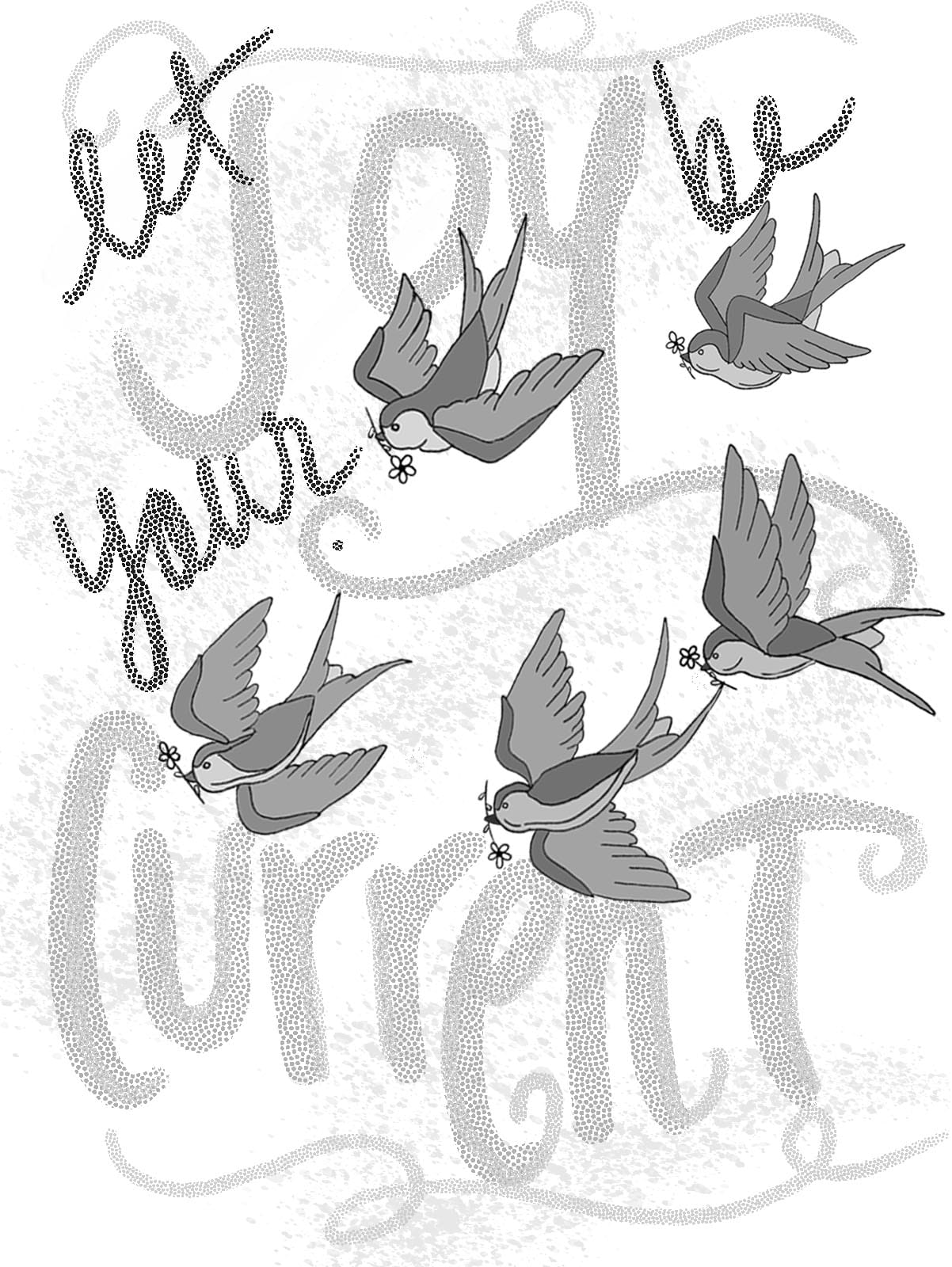
[Caption: Let Joy Be Your Current — by Nikolas Lee & GPat Patterson]
The Daisy Chain spreads through offline free-range conversations between peers, clubs, groups, associations, and organizations of all kinds. That is why one of the most powerful things people can do is actually get to know their neighbors.
As a viable movement-building practice, The Daisy Chain is more likely to grow if:
- people hear about it from a friend or someone in their neighborhood
- people are frequently invited to practice daisy-chain “team lifts”[19] in their neighborhoods.
This is how The Daisy Chain takes root: through repeated invitations to play and experiment. We all win, when we all play.
Using The Daisy Chain to Joyfully Seed a Mass-Movement
In order for The Daisy Chain to spread to regional, national, and international murmurations, we must get intentional about seeding The Daisy Chain in wider and wider concentric circles. The good news is that The Daisy Chain heuristic can be used to sow movement-building seeds across large geographic areas.
A viable method of seeding mass-movements is for Luminaries and Menders to come together. Luminaries and Menders collaborate with each other to shift their neighbors’ sense of what is possible. They do this by creating impromptu (and sometimes planned) social happenings that invite neighbors to play, create, imagine, and learn.
In many social movements, messages of an emerging people-power movement are carried across space and place by artists, visionaries, and educators, who create social happenings that accomplish two things:
bring people together through uplifting art and play-based experiences
make a point to amplify local movements (not astroturfed ones).
As author Toni Cade Bambara[20] reflects, it is the artist’s job to “make the revolution irresistible.”
When Luminaries and Menders intentionally create free public spaces for celebration, imagination, and consciousness-raising, word spreads fast, draws local crowds, and radiates outward into ever-widening, on-the-ground social circles.
Local artists, educators, and dreamers are the conduits through which pro-social change spreads and takes root[21]. A movement without joy will wither on the vine. This is precisely why political abusers try to create a dispiriting effect on their targets: emotion drives movements and flat-out nothing beats joy, because joy is our most pro-social emotion.
Joy has never been a flimsy thing: it is the engine[22] of a people’s innovation, resistance, resilience, solidarity, and collective courage.
“What Can I Practically Do, Besides Read This Zine?”
If you want to show your appreciation for these words + illustrations, we would be honored if you spent 2-3 hours each week in humble service to your neighborhood: together, offline, off-screen, and off “work-time.”
Chapter 3 Footnotes
For example, a problem all of us are going to need to figure out here soon is how to keep neighbors fed during a food system collapse. ↩︎
One example of a worthy goal might be increasing a positive presence in our neighborhood in order to boost community morale. ↩︎
It’s akin to regularly drinking water, eating healthy foods, brushing and flossing teeth, and getting regular sleep and exercise. It’s essentially practicing community hygiene. ↩︎
Older white adults are over-represented in suburbia and, in general, they are routinely regarded as harmless. Suspicion slides right off them. Use that to make good trouble. ↩︎
I was trying to be cute here. I mean suburban and rural areas. ↩︎
adrienne maree brown’s ground-shifting book, Emergent Strategy: Shaping Change, Changing Worlds, is essential reading for anyone who wants to understand how social movements grow, thrive, and sustain themselves. See also Andrea Ritchie’s book, Practicing New Worlds: Abolition and Emergent Strategies, which drills down into how movement organizers might respond to and anticipate political abuse. ↩︎
Political abusers create chaos. The Daisy Chain creates a stabilizing game plan. ↩︎
For more insight on how this practice is related to creating right relationship, see Hiroki Kiyokawa’s essay “Returning to the Earth,” published by the Musubi Academy. ↩︎
This excerpt is from Octavia Butler’s famous book Parable of the Sower. Not only is Butler known for her excellent science fiction and speculative fiction writing, but she is heralded as having anticipated the political circumstances in which we currently find ourselves. ↩︎
As the descendant of Lenape, Irish, and Polish peoples, I’m no “true believer” in nation states founded on genocide and chattel slavery. You don’t get to roll up into someone’s home, murder them, and then write your own lease. Except that’s exactly what the delusional colonizers do. That said, from a harm reduction perspective, I do see voting as a tool to break free from the political hostage-taking of a two-party system. At the same time, it is foolhardy to assume voting can free us from systems quite literally founded on theft, murder, and national gaslighting. We must move outside and around these systems to prevail. ↩︎
Bluesky, Mastodon, PeerTube, Pixelfed, and Ghost, are examples of federated social media. Facebook, Instagram, YouTube, TikTok, and Substack are oligarch owned social media, which is why everything is enshittified: it’s to block our field of vision. ↩︎
We can argue, back and forth, that “AI is just a tool,” but that tool is not neutral. It has been created by fascists, who do not believe ordinary people or the planet deserve to survive. Their creators have been instrumental in committing genocide and destroying a people’s right to self-determination all across the globe. What’s more, “data centers,” which appear to be the apparatus for a surveillance state meant to keep us in an open-air prison, are destroying communities, despoiling land, stealing water, and and plunging vulnerable communities into climate collapse. I won’t argue with settler-colonial logic. No tech is more important than the tapestry of life. ↩︎
Without security forces, political abusers are just cowards in gilded cages. This is why the deescalate petal of The Daisy Chain is so important. ↩︎
When we refuse to want what they’re selling, techno-fascists and political abusers lose their lure. This is why the share petal of The Daisy Chain is so important. ↩︎
If you’ve never heard of time banks before, hold onto ya butts [said in Tine Belcher fashion]. Time-banks move outside and around the exploitative logic of capitalism by trading in the most precious (and unriggable) currency we have: time. You can learn more about time-banks at TimeBanks.org. Time banks are literally everywhere and literally awesome. ↩︎
I highly recommend watching Ben McKenzie’s documentary Everyone is Lying to You for Money. It’s free to watch, and oligarchs are trying to block the film, because it really is true that everyone is lying to you for money. ↩︎
I realize that some devices, like hearing aids, do not fall under this category. Remember, there are exceptions for everything. Read for opportunity not rejection. ↩︎
This is a quote from elder Grace Lee Boggs’ book The Next American Revolution, where she discusses the ways that ordinary people can mitigate and slow climate collapse (even working to restore the planet) by learning how to live simply and work collectively. As we have seen with the perverse rise of oligarchs: having a bunch of stuff doesn’t correlate to fulfilling relationships, peaceful living, or having a larger sense of purpose. ↩︎
Whether you refer your use The Daisy Chain’s terminology is immaterial. The Daisy Chain is merely a heuristic reflecting the best of what we’re already doing— and pointing us toward collective potential. You don’t have to call these things “daisy chain team lifts.” I just need shorthand phrases to write this. ↩︎
This quote comes from ‘An Interview with Toni Cade Bambara: Kay Bonetti’, published in Conversations with Toni Cade Bambara and edited by Thabiti Lewis. The book was published by the University Press of Mississippi (2012). Her insight showcases incredible wisdom: a depressed and hopeless people cannot move out of a chronic freeze state. They will remain passive, isolated, and (as a consequence of that isolation) helpless. ↩︎
This is precisely why political abusers like JD Vance and Peter Thiel refer to educators as “enemies of the people.” This is also why political abusers, like the Ellison family, have sought to buy up all media— because they are terrified of the People’s collective genius. ↩︎
In their book Joyful Militancy: Building Thriving Resistance in Toxic Times, Nick Montgomery and carla bergman make an important distinction between joy and happiness. They explain that, in contrast to happiness, joy can help people get out of a rut when it comes to habitual feelings and actions. They write: “Bubbling up in the cracks of Empire, joy remakes people through combat with forces of subjection …Whereas happiness is a numbing anesthetic that induces dependence, joy is the growth of people’s capacity to do and feel new things, in ways that can break dependence” (60). Joy is, in a sense, an emotion directly tied to our collective sense of agency to create the world we want to see together. ↩︎

Member discussion: