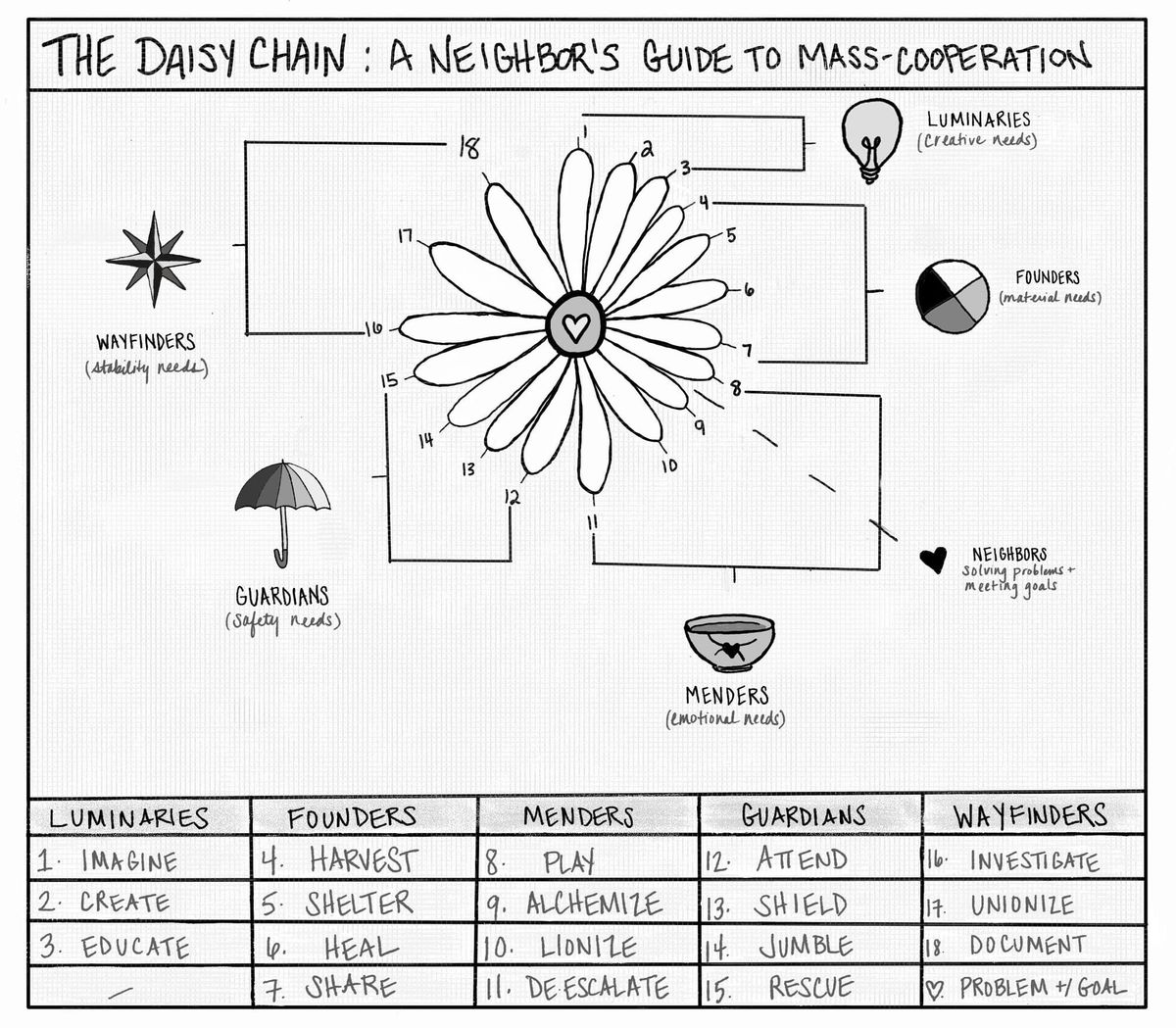
At its core, The Daisy Chain is a heuristic, which (by definition) is a creative device that helps people think through challenges and solve problems. Heuristics take many forms, but they often rely on an easily remembered metaphor or compelling visual. The Daisy Chain features a flower.
In the visual representation of The Daisy Chain heuristic (below), the center of the of the flower represents a problem, or goal, neighbors must confront—whether it’s increasing a sense of neighborhood camaraderie, developing neighborhood responses to climate-related emergencies, protecting our neighbors from being targeted by violent political abusers, or anything in between. Surrounding the daisy’s center are 5 thematic clusters, with 18 petals total. Each petal represents different types of actions that neighbors— with diverse skillsets, perspectives, and resources— can leverage to collectively approach a problem or solve a goal.
- Luminaries (lightbulb; 3 petal types) help neighbors imagine the world they want, educate their neighbors of all ages, and create art of all types that amplifies this vision
- Founders (medicine wheel; 4 petal types): help neighbors harvest food, secure reliable shelter, access the medical and psychological supports needed to heal, and share what they have with each other
- Menders (kintsugi bowl; 4 petal action types): help neighbors play together to boost morale, collectively alchemize big emotions, lionize scapegoated community members, and deescalate security forces who have been manipulated to turn against their neighbors
- Guardians (umbrella; 4 petal types): help neighbors attend to their communities and create a felt sense of safety, shield their community from prying eyes, jumble abusers’ ability to effectively target scapegoats, and rescue neighbors from ecological (or other) disasters that require an emergency response
- Wayfinders (nautical wheel; 3 petal types): help neighbors investigate those enacting political abuse, unionize into neighborhood groups that organize their communities, and document a plan that articulates their neighbors’ vision of the future into fine print.
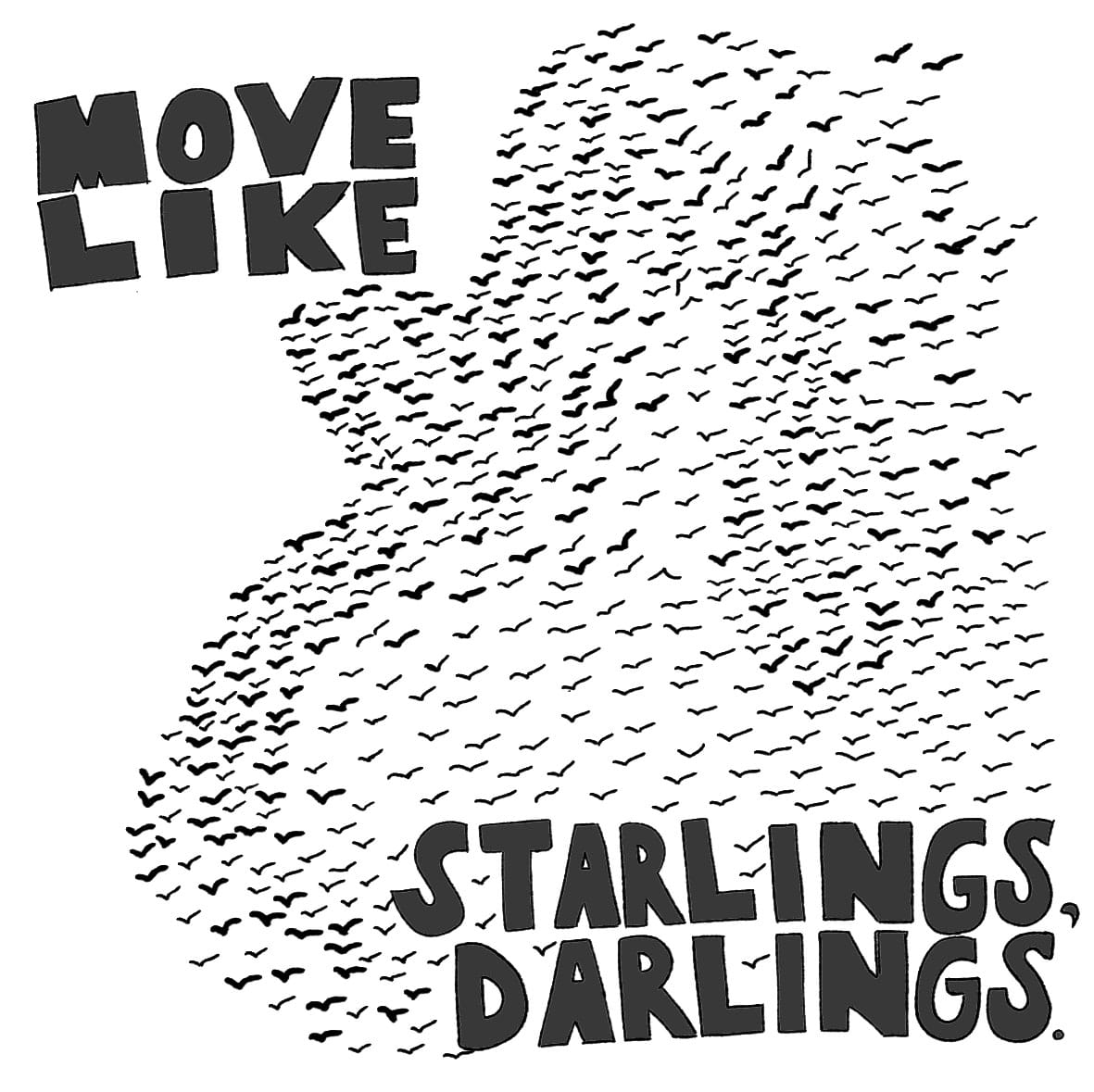
The goal of this heuristic is to help us channel our millions of protest numbers into a national movement, which is rooted at the neighborhood level and capable of flocking together in a massive networked murmuration. This is how we build the kind of movement, across a large land mass, capable of uprooting an authoritarian coup and growing the world we want— one that centers the needs of ordinary people and the planet.
Unlike project management, the central question of The Daisy Chain isn’t just how an objective might be met but, rather, how neighbors might accomplish whatever is in front of them with a level of creativity, play, and a joy that inspires bystanders to become upstanders. Rather than work separately or receive top-down orders, the goal is to allow power to flow horizontally between neighbors so that they can leverage their unique skills, get out of each other’s way, and move in a flock-like murmuration in order to get things done. To help explain what is meant by a murmuration, refer to the corresponding imagine of starlings— each of them small, unique, separate beings— moving nimbly together as a whole.
If you want to develop an understanding of how tiny units can work together as a whole, I recommend watching the children’s film *Big Hero 6[1], paying close attention to the main character’s invention of microbots. Better still, since the organic is always better than the artificial, you can also look to the sky and appreciate how starlings move in murmuration with each other— or watch it here.
Let’s move like starlings, darlings.
A Taxonomy of The Daisy Chain's Petals
The following section helps readers understand, at a basic level, the types of actions neighbors might collectively address problems and meet goals in their neighborhood—with the aim of resisting political abuse through. The information below is organized around the 5 thematic clusters of The Daisy Chain. Each section opens with a symbolic image that depicts the cluster, along with a description of what the cluster does. Underneath the description of the cluster itself are brief descriptions of the 3-4 action petals that comprise the cluster and how each petal in that cluster can be used to uproot political abuse.
Note: This section does not list concrete actions. To understand how each of The Daisy Chain’s 18 petals can be mobilized into over three hundred concrete actions, it is essential that readers engage with the appendix. The Daisy Chain’s appendix is not skippable; it illustrates how to move from an idea of building people-power to actually practicing people-power.
―⚘―
The Luminaries Cluster
Luminaries fuel their community’s emotional reserves, modeling courage, clarifying purpose, and offering a robust sense of hope. Luminaries are an essential cluster of The Daisy Chain, because they help shift us from responding to political abuse to shaping the world we wish to bring into being. The Luminaries cluster includes the imagine, create, and educate petals, whose descriptions follow:
Imagine Petal
Imagineers host events and create spaces for their neighbors to come together and discuss a vision of our near (and far) future that would actually feel life-affirming for ordinary people and life-protecting for the planet, which sustains life itself. Because of their systems-level thinking, Imagineers center often ignored voices, because they understand that to build a genuinely functional society, no one can be left behind. Similarly, Imagineers seek out young people’s perspectives about the world they will inherit, and they amplify young leaders in the movement toward our collective liberation and evolution. Neighbors who are drawn to this petal are those allergic to cynicism and micromanagement. They rebuke gatekeeping phrases like “that’ll never happen” and, instead, listen to their communities desires for a functioning society by responding, “yes, tell me more!” Imagineers collaborate across all petals of The Daisy Chain, but they have a special relationship with the Document[2] petal, of the Wayfinders cluster.
Note: The imagine petal provides the counterweight to political abusers, who claim their vision of the world is the only one that exists so that ordinary people assume things can never change for the better.For details about the kind of actions the imagine petal might take to uproot political abuse and meet longterm community goals, refer to the appendix.
*Big Hero 6 *clearly got the idea of “microbots” from watching starlings move together. Human beings always learn from animals; they’re wiser because they’ve been around a whole lot longer than humans. ↩︎
The document petal is the last petal discussed in this chapter. The Imagineers and the Documenters are presented here as intentional bookends, whose petals overlap and complete the circle of The Daisy Chain. ↩︎

Member discussion: