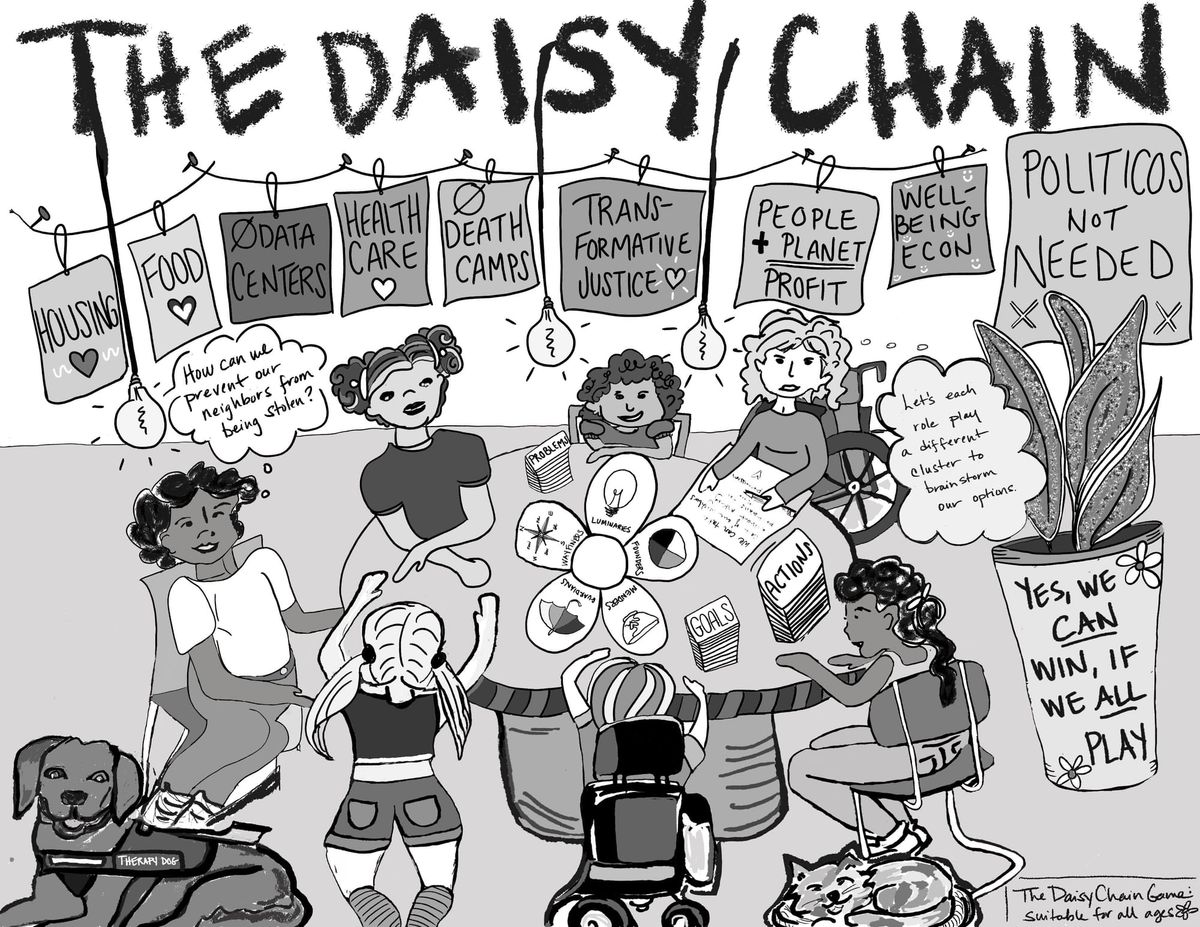
This zine helps ordinary people uproot political abuse and grow the world they wish to leave behind. I write this from the the United States[1], a framing which feels important to emphasize because the U.S. has, for centuries, been the epicenter of exploitation and abuse, at home and abroad. The only people who can break the cycle are ordinary people who’ve had enough. The task before us requires no special skillsets, beyond using what time, talents, and resources we already have to upend the loop of violence and exploitation that has become our collective national nightmare. As the adults in the room, we owe it to our children and to all young people, human and non-human, who will inherit the consequences of our actions and our inaction.
Though this zine was written from inside the belly of the beast, that does not mean the ideas here cannot be adapted to other communities, countries, and contexts. In fact, to my knowledge, neighbors are adapting this zine to meet goals and confront challenges in at least three different countries, beyond the States. So, wherever [2] you happen to be reading this, I invite you to run with what inspires you, adapt to your circumstances, and leave the rest.
For those reading this within the U.S., you may notice that I don’t mention elections or appealing to elected officials in this zine. My silence on these points does not mean that I don’t think people ought to vote; nor does my silence imply that people should not engage with their local governments. Please vote. Please show up at your community council, library, and school board meetings. Please attend your union meetings. Please run[3] for office.
Just because I have not explicitly written about these things does not mean they don’t matter. Besides, we’ve been told, over and over again, to do these things. We know the drill, just as we also know, down to our marrow, that engaging with these institutions is nowhere near enough to confront the challenges we face and the danger our country poses to neighbors around the world. The United States is an abuser at home and a bully abroad, and it is down to all of us to be good, responsible neighbors and put a stop to the abuse. This is not an insurmountable task.
But to even have a chance to intervene, we need to recognize that much of our political power, as a people, has been hoovered up in an intentionally dispiriting game of Monopoly, which our own institutional figureheads (from city hall to the oval office) refer to “changing the system from within.” This narrative that we can change rigged systems from the inside is a trap, meant to keep people exhausted, frustrated, and ultimately checked out. I depict the game we’ve been asked to play in the illustration below.
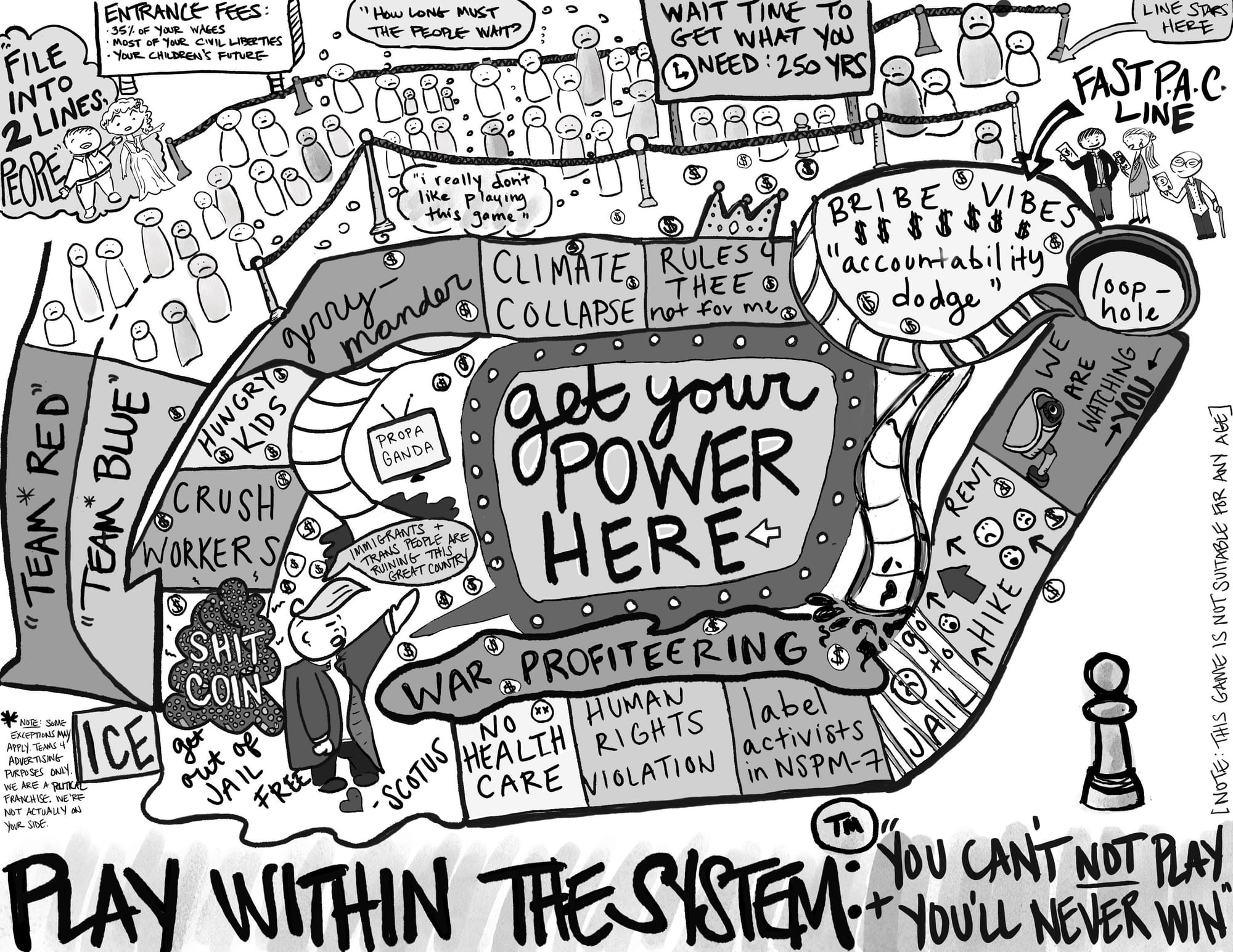
In the pages that follow, I describe a heuristic, called The Daisy Chain, which illustrates that ordinary people’s power is far more expansive than our capacity to vote or even our ability to successfully participate in what are increasingly unfree and unfair elections. Even if our political abusers effectively wage a coup against their own people, by openly cheating and refusing to seat duly elected officials, we still have more power than they do.
People with actual power don’t need to lie, cheat, and abuse. That’s a sign of weakness. There are hundreds of ways we can use what we already have, where we’re at, to shift the balance of power out from under the people who are abusing us.
Given the scale of the challenges we face, which include extinction-level ecological collapse, it’s not enough to simply say “no” to abuse. Ordinary people need a collective vision of the future that enables us to move forward together, with purpose. Related, we need to shift from vague calls to “get involved” in our communities and move toward developing tangible action plans. Our plans must remain nimble enough so that we can tailor them to our circumstances as they change. As an added challenge, the organizing in which we take part must remain joyful enough that we are able to sustain the energy needed to play our own long game—instead of remaining trapped in a coercive game that’s been forced upon us for the better part of two-hundred-and-fifty years.
I invite readers to experiment, offline, alongside their neighbors, with the ideas described in this zine.
The task before is to pull the rug out from under our political abusers and co-create a world that works for ordinary people and the planet. Rather than view ourselves as stuck in a rigged system where the people and the planet were never meant to win, our collective goal is to build a better game— one that moves outside and around the institutions that have been boobytrapped against us. We’re not actually as stuck in this coercive game of Monopoly as we’ve been encouraged to believe: they need us to play along, they need us to comply, they need us to believe their lies, and they need us to turn our heads and look the other way when our neighbors are harmed.
Our goal is to take our numbers from No Kings, Standing Rock, Women’s March, Black Lives Matter, Sunrise Movement, Occupy, Disability Rights movements, Poor People’s campaigns, Moral Mondays, Immigrant Rights movements, union movements, and every Pride protest around the country and, together, shape-shift from occasional protests (when things go wrong) into a massive web of leader-full neighborhoods (where we make things right, together).
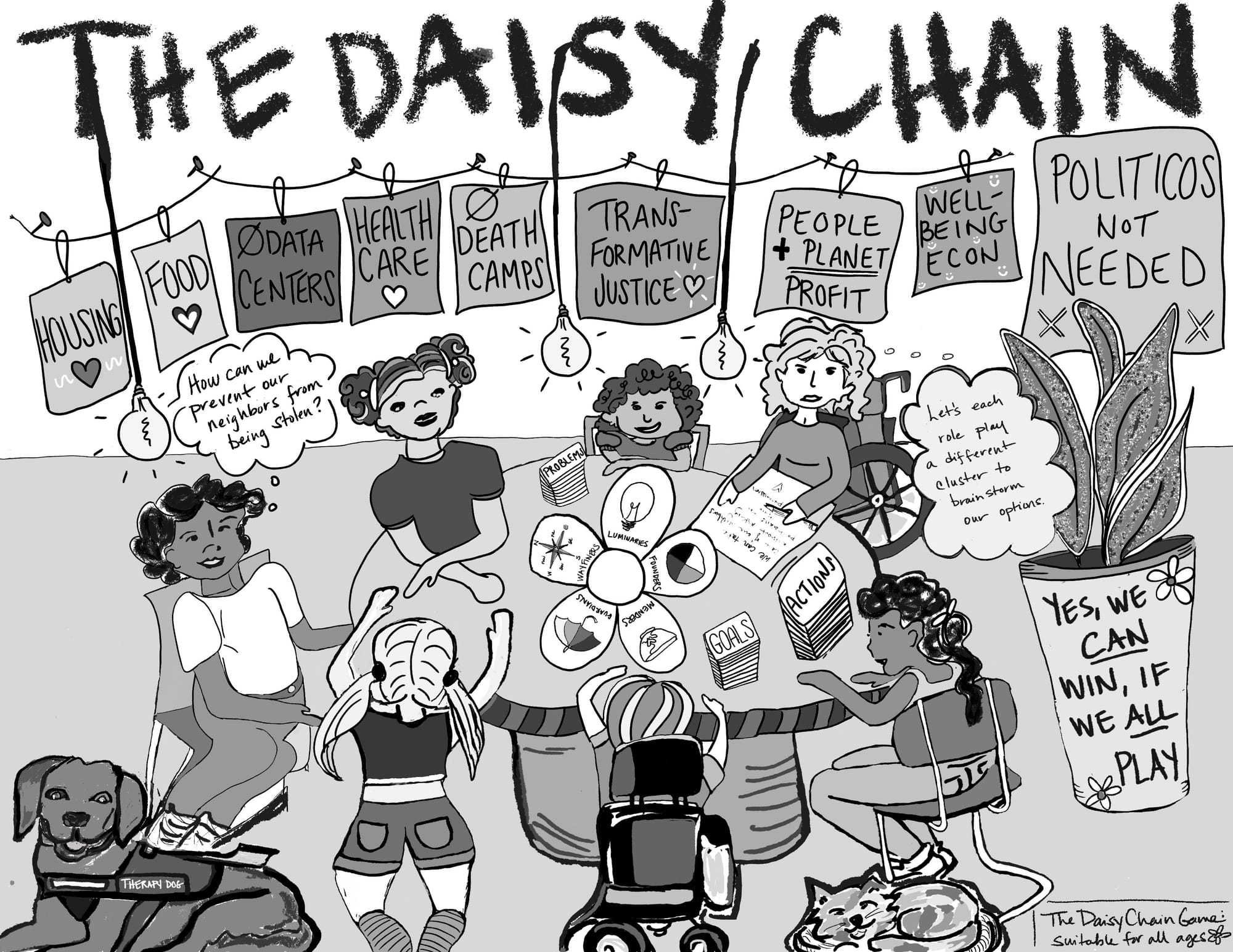
We must resolve to do for each other what our political abusers have told us (for so long) is “impossible,” which they have insisted is impossible precisely so that we remain weak, disconnected, and perpetually on the back foot. Abusers need us weak because there are more of us than there are of them; it is time to reclaim our power and get stronger by working and playing together (as I illustrate in the image below).
Though I write this from the perspective of a researcher [4], this zine is emphatically not academic. We are well past the time for book clubs and armchair critiques. Though I am indeed a talented educator, it would be a mistake to regard this zine as a set of top-down instructions, meant to be adopted, whole-cloth, across communities and regions with unique topographies, vulnerabilities, strengths, resources, and cultural values. Rather, I wrote this zine to mirror back to people what we have always done during times of crisis: evolve & help one another.
This zine is not meant to be perfect; a single person cannot think of everything. It would be hubris to assume otherwise. This document is meant to be played with, practiced, and adapted to your community. In fact, the only way to misuse this document would be to talk about it from the comfort of your own home— without taking it to your neighbors, developing home-court ideas, and doing the courageous and vulnerable labor of working together. This zine is not meant to sit on someone’s bookshelf; it is a living document waiting to be animated by communities across the country, who refuse to cede their power to a cabal of political abusers who intend to maintain their grip on coercive control by going to war against their neighbors abroad and terrorizing their neighbors at home.
Finally, while this zine employs whimsy and homemade drawings to inspire readers, its aim is serious. Unlike many functioning governments around the world, the United States never bothered to develop a civilian-based defense[5] plan to help ordinary, unarmed people resist a coup. Literally, every functioning democracy has one. But we don’t. Rather, than accept responsibility for the people living in the United States, our government leaders propagandized us into believing such plans[6] weren’t needed, because the United States was exceptionally “free” and that, should someone try to wage a coup, “the might of the U.S. military” would protect ordinary people against all threats to our democracy, both “foreign and domestic.”
We are now living under an active siege on our democracy and, because of the United States government’s own negligence, we are without a coordinated plan for ordinary civilians, committed to nonviolent conflict, to defend our neighbors from tyranny.
At present, in the United States, we are living under the petty enforcement of people who have abdicated their responsibilities to the people in order to enrich themselves. To put a fine point on the matter, we have an (alleged) Commander in Chief, Vice President, Speaker of the House, Supreme Court, Secretary of Defense, Director of the Federal Bureau of Investigation, and head of the Department of Homeland Security who have each, in turn, stated their intent to treat ordinary people in the United States, who object to their own abuse, as if they are “enemies of the people.” This is obviously an example of bad actors projecting their own sins onto those courageous enough to stand up for their neighbors. And, as a public educator, I rebuke it.
For all these reasons, this zine’s focus on scaling up neighbors’ ability to care for one another at the local level and coordinate with neighboring communities isn’t just some fanciful idea reminiscent of Sesame Street. The ideas articulated in this zine illustrate how we pull the rug out from under the domestic abusers who are disappearing our community members and executing our neighbors in the streets. Power lives in our neighborhoods, and if we don’t learn how to harness it and work together, we will allow ourselves to be steamrolled by amoral, untalented, and unrepentant villains.
If my approach seems “cutesy,” consider that it’s much easier to teach people how to harness play to organize under duress than it is to repeatedly point to the monster on the horizon, offer no material plan, and demand that “somebody do something”— all in full view of the children looking to us to provide them safety.
As a public educator, I find that focusing on our collective agency, insisting on our right to author our own future, and protecting our children—with creativity, courage, and joy— is the correct tone to strike for the challenging (but not unsurmountable) moment before us.
For every alarmed politician telling the people to “rise up” and “wake up,” this zine answers that call by explaining, in as much detail as possible, precisely how we go about doing that.
This zine, presented here in separate posts, includes seven chapters, a conclusion, and an appendix. The following chapter roadmap will help prepare you for what’s ahead:
In Chapter 1, I define what power is, where it lives, and why ordinary people are exactly the leaders we need for the crises we face. In Chapter 2, I define The Daisy Chain as a visual metaphor (i.e. heuristic) for how people can work/play together by pooling their time, talents, resources, and skills. In Chapter 3, I explain how neighbors can use this heuristic, not only to organize within their communities but also between communities and across large topographical areas— with the ultimate goal of growing a national resistance movement with the ability to turn on a dime, whether what’s required is mass-cooperation between neighbors or mass-noncompliance toward our political abusers. In Chapter 4, I offer practical tips to make sure our efforts at grassroots mass-cooperation succeed. In Chapter 5, I anticipate how conflict might arise and offer ways to reframe conflict as an opportunity to adapt. In Chapter 6, I offer a play-based strategy to move from reading this zine to actually practicing it in your neighborhoods. In Chapter 7, I offer practical advice for how to meet people in your neighborhood, who see what you see and who are invested in standing up for their communities. In the conclusion, I explain why ordinary people actually have the upper hand when it comes to standing up to our political abusers. Finally, in the appendix, which is the most important section of the zine, I include over 300 actions ordinary people can take to collaboratively upend political abuse. The appendix, which functions as a living document (meant to have actions added to it) ultimately puts to bed the false notion that there’s nothing ordinary people can do to change their fate and protect future generations. That’s simply not true.
Things to Keep in Mind as You Read This Zine
- If you are someone who has never had to organize from the margins of society, this document may seem overwhelming to you, because you’re still processing the fact the our institutions are rolling over to protect themselves and not the people. That news can be jarring to newer targets of political abuse. To mitigate that overwhelm, take breaks when engaging with this document and remember that discomfort is a natural part of growth; we have a responsibility (to our kids and to our neighbors) to act like grownups and alchemize our discomfort into meaningful action in the here and now.
- The objective here isn’t for a single micromanaging person to attempt to do everything at once (or to act as a lead organizer). This zine describes a living ecosystem of actions. If readers put 2-3 hours a week into playing with the ideas described here—together, offline, in your neighborhood—that will be enough to shift our political direction, especially if we recruit our neighbors along the way. Because we must all play our part.
- Related, the goal of this zine is not perfection but, rather, experimentation. The idea is to create a neighborhood movement so rich, so joyful, so brilliant, and so textured with opportunities for involvement that it transforms bystanders into upstanders.
- To make the information in this zine more approachable, I include hand-drawn art that helps people better understand how to organize. A load-bearing image in this zine depicts a daisy with eighteen petals— where the center of the daisy hosts a community problem/goal, and the petals around the center represent different action types people can take to address that problem or meet that goal. I further organize those eighteen petal types into (five) thematic clusters— with their own unique symbols—to show how some petals (actions) overlap with one another. If it helps, consider the five thematic clusters akin to suits in a deck of playing cards. For those inclined to tabletop gaming, the art in this zine can be printed out and turned into a DIY cooperative game to help your neighbors organize.
- Finally, I have included footnotes in this document for people who appreciate cited sources, additional reading, and commentary that feels relevant but might have otherwise disrupted the flow of the document. If you’re not a footnotes person, skip ‘em.
The United States, which has gotten in the habit of renaming things through land-grabs, has a true name: Turtle Island. Turtle Island is the unceded territory of our First Nations neighbors, many who welcomed incompetent immigrant neighbors from Europe— only to be murdered by them, driven off their lands, pushed out of their homes, forcibly separated from their cultures, and robbed of their children, their women, and their Two Spirit wayfinders. In spite of the barbarity and depravity waged against them, First Peoples are still here, and they always will be here. If we want something that feels like a genuinely livable life— for ourselves and for our children—we would do well to return Turtle Island to Herself and stop taking advice from the great-great-great grandchildren of genocidaires and enslavers, who are leading us to our collective extinction. ↩︎
Ordinary people in the US are organizing. Understand that there is an enormous divide between the integrity of ordinary people and the amoral politicians who have seized our institutional levers to enrich themselves— mainly by looting and destabilizing vulnerable communities at home and in the global South. ↩︎
Especially run for office if you have the integrity to resist accepting political bribes and refuse trafficking in propaganda ↩︎
I specialize in play-based adult education and people-powered technical communication. ↩︎
For further reading on civilian-based defense, please refer to Gene Sharp’s book Civilian-Based Defense. It is free to download from the International Center for Nonviolent Conflict. Sharp is talking about how ordinary people engage in strategic nonviolence to upend authoritarian coups. ↩︎
Not only did the U.S. never bother to develop a civilian defense plan, in the event of the rise of a strongman, but just as recently as September 2026, the U.S. military refused to take part in multinational discussions about how to protect civilians during time of warfare. Both of these data points demonstrate homicidal negligence and brutal disregard of humanity and life itself. ↩︎

Member discussion: